Guide
Compressor, sealed system, refrigerant leak: three words that are not interchangeable
These three words get used as though they mean the same thing, and they do not. The sealed system is the entire closed refrigerant loop: compressor, condenser, filter-drier, metering device, evaporator, and the tubing brazed between them. The compressor is one component inside that loop. A leak is a fault of the loop rather than of any particular part in it. The distinction matters because sealed-system work is the most expensive thing on a built-in refrigerator to be wrong about, and most calls that arrive sounding like a sealed-system failure are not one: they are a condenser nobody has cleaned, a stopped evaporator fan, or a defrost circuit that has quit and iced the coil solid. Knowing what each word means is what lets an owner tell a real diagnosis from a guess with an expensive number attached to it.
What is actually inside the loop
The compressor raises the pressure of the refrigerant and pushes it to the condenser, where the heat taken out of the cabinet is handed to the room. From there it passes through a filter-drier, which traps moisture and debris, and then through the metering device, which on this class of appliance is usually a capillary tube: a long, very fine bore that drops the pressure by restriction alone rather than by any moving part. The low-pressure liquid boils in the evaporator, absorbing heat from inside the cabinet, and the vapor returns to the compressor. The whole loop is brazed closed and holds a measured charge, and on domestic refrigeration that charge is small enough to be weighed rather than judged. Nothing in it can be opened without recovering the refrigerant first, which is federally regulated work. Once it is open, humid air is the enemy: the drier is replaced every time, a deep vacuum is pulled to boil off any moisture that got in, and the charge is weighed back in. That sequence, not the price of any part, is where the cost of sealed-system work comes from.
- Compressor: the pump, and the only part of the loop with moving components
- Condenser: the finned coil behind the grille where cabinet heat leaves for the room
- Filter-drier: a one-time part that traps moisture and debris, replaced whenever the system is opened
- Metering device: a capillary tube on most domestic refrigeration, sized to a specific charge
- Evaporator: the coil inside the cabinet where liquid refrigerant boils and takes heat out of the air
- Tubing and brazed joints, plus any service access, which is where most leaks are eventually found
How a compressor actually fails
A compressor fails in three recognizable shapes, and only one of them is expensive. It can refuse to start, which sounds like a hum or a click for a few seconds followed by silence, repeating every few minutes as the overload protector opens and resets. That is very often the start relay or capacitor rather than the compressor, and it is also what a perfectly healthy compressor does when the condenser fan has died and it has cooked itself into an overload trip. Fix the fan and the compressor comes back. It can run and not pump, which shows up as low current draw, a suction line that never gets cold, and no meaningful temperature difference across the condenser. Or it can fail electrically, with windings gone open or shorted to the shell, which is measured at the terminals with the leads off. The honest note is that a genuinely failed compressor is not the most common thing found on this class of equipment. These compressors are unhurried and heavily built, and they routinely outlast the kitchen around them.
How a leak announces itself, and how it fools people
A system that has lost part of its charge does not stop cooling. It cools partly, which is far more confusing. The classic sign is a frost pattern that starts on the first section of the evaporator and stops part way along, because there is no longer enough liquid to boil across the whole coil. The unit runs long, sometimes continuously, and the cabinet sits a few degrees warm rather than warm. Everything electrical checks out, which is exactly why owners describe it as running all the time and not being as cold as it used to be. A system that has lost the lot is simpler: the compressor runs, the suction line stays at room temperature, and nothing gets cold anywhere. Leaks are found at brazed joints, at rub-throughs where a tube has been resting against a bracket or another line for twenty years, at corrosion on the evaporator, and at bolt-on piercing valves that somebody added for a quick charge and left in place. Those seal on a gasket and leak later, which is why a proper access is brazed in instead.
- Frost that covers the first part of the evaporator and stops, leaving the rest bare
- Run time that has crept up to continuous while every electrical test comes back clean
- A cabinet a few degrees off rather than warm, holding overnight and losing ground through the afternoon
- A suction line at room temperature with the compressor plainly running
- Oil staining at a joint or on the tubing, which is refrigerant oil marking the exit route
Why a top-up is not a repair
A sealed system does not consume refrigerant. If the charge is low, it left through a hole, and that hole is still there after somebody adds more. There is a second reason a top-up is poor practice on this equipment: a capillary-tube system has no receiver holding a surplus, so it is matched to one specific charge weight. Undercharge starves the evaporator and overcharge floods it, and both produce poor cooling that looks broadly similar from the front of the cabinet. Charge gets recovered, the leak found and repaired, the drier replaced, a deep vacuum pulled, and the correct weight put back. Skipping the vacuum is the shortcut that comes back worst, because moisture left in a capillary system freezes at the outlet of the cap tube and produces an intermittent restriction: cooling that works, then does not, then works again after a defrost, with no failed component anywhere to find.
Two systems, not one
On a Sub-Zero built-in this conversation has a fork in it that most refrigerators do not. Dual refrigeration means the refrigerator and the freezer are cooled by two entirely independent sealed systems, with no air passing between the compartments at all. So the sentence the sealed system has failed is incomplete until somebody says which one. It also means the appliance carries its own control sample. A freezer holding hard while the refrigerator drifts proves that one complete circuit, its compressor, its condenser airflow, its controls and the power feeding all of it, is in good health, and it moves the search onto the other circuit or, far more often, onto something that is not refrigeration at all. It changes the arithmetic of a repair too, because attending to one circuit of two is a smaller job than a single-system appliance where the whole machine stands or falls on it.
The order a sealed system should be reached in
The sealed system is the last thing examined, not the first, and the checks ahead of it are quick. That order is what separates a diagnosis from an expensive opinion. The cheap end of this trade is a start relay, a condenser fan or a coil that needed clearing. The middle is an evaporator fan, a defrost heater, a thermistor or a gasket. The expensive end is a compressor or a leak repair, and on an appliance far enough along in years that is where repair or replace stops being rhetorical, with the qualification that a built-in is a fitted part of the kitchen and the opening it sits in was framed once. What should prompt a second question from an owner is a sealed-system quote that arrives without any of the earlier work having visibly happened, without gauges ever having been connected, or without anybody having looked behind the grille.
- Condenser condition and the whole airflow path, grille through to the surround
- Condenser fan and evaporator fan, current draw measured rather than listened to
- Defrost heater continuity and thermistor resistance read against the table published for that model
- Door seal pull and cabinet alignment, measured rather than eyeballed
- Control readings and any stored fault history the generation keeps
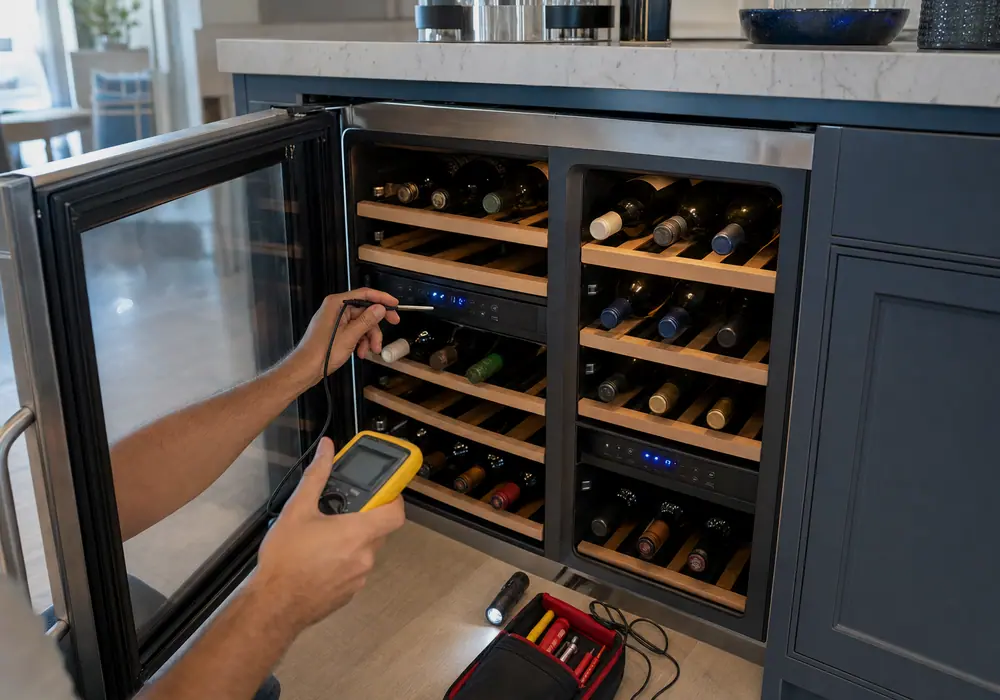
- Then temperature split across the condenser, frost pattern along the evaporator, compressor current draw, and pressures through a proper access
Questions
Frequently asked questions
Can refrigerant run out over time the way oil gets used up?
No. A sealed system is a closed loop and consumes nothing; the same charge circulates for the life of the appliance. So a system that is low has leaked, and the leak is still there whatever anybody adds to it. Anyone offering to top it up without finding where it went is selling a date for the next call rather than a repair. That is a two-minute call to Temecula Valley Sub-Zero Appliance Repair Specialists on (858) 465-4117.
The technician says the compressor is bad. How would I know that is right?
Ask what was measured. A compressor is condemned on numbers: current draw under load, winding resistance at the terminals with the leads off, resistance to the shell, and whether the suction line gets cold. Ask what the start relay and capacitor tested at, and whether the condenser fan was running. A dead fan trips a healthy compressor on overload. Temecula Valley Sub-Zero Appliance Repair Specialists, Temecula: (858) 465-4117.
My freezer is fine and my refrigerator is warm. Could that be a refrigerant leak?
It could, because dual refrigeration gives the refrigerator its own sealed system that can fail alone. But it sits near the bottom of the list, under a stopped evaporator fan, a defrost failure icing that coil, a thermistor reading the compartment wrong, and a condenser too loaded to shed heat into a hot afternoon. A diagnosis that jumps straight to refrigerant deserves a question. Say so when you call Temecula Valley Sub-Zero Appliance Repair Specialists on (858) 465-4117.
Appliance down in Temecula?
Tell us the brand and what it is doing — we can usually name the likely repair before we arrive.